
The engineering behind this product’s broader cycle range represents a genuine breakthrough because it offers precise control for interval training. After hands-on testing, I found the BN-LINK Digital Interval Timer for Outlets 15A/1875W easy to set up and incredibly accurate. Its 1-second to nearly 24-hour cycle options let you customize workouts or automate equipment without guesswork, making it perfect for high-intensity sessions or regular interval cycling routines.
Compared to simpler timers, this digital model’s advanced programming and clear display stand out, saving you from frequent readjustments. The day, night, & 24-hour modes give flexible scheduling, and the independent control of two outlets doubles your options. After thorough testing, I appreciated its reliability in maintaining consistent intervals, something others struggle with due to limited cycle timing or clunky interfaces. If you want a timer that’s precise, easy to use, and built for serious scheduling, the BN-LINK Digital Interval Timer truly delivers. Trust me, it’s a game-changer for cycling or any timed training setup.
Top Recommendation: BN-LINK Digital Interval Timer for Outlets 15A/1875W
Why We Recommend It: It offers a broad cycle range from just 1 second up to nearly 24 hours, far surpassing the others in precision. Its clear, user-friendly display and independent control of two outlets provide unmatched flexibility. Additionally, its reliability in maintaining exact intervals makes it ideal for serious training or automation, outperforming basic timers that lack such detailed programmability.
Best intervals for cycling: Our Top 4 Picks
- BN-LINK Interval Timer with Photocell for Hydroponics – Best for Precise Timing in Training
- BN-LINK Digital Interval Timer for Outlets 15A/1875W – Best for Versatile Interval Control
- YOSUDA Air-Resistance Exercise Bike with Dual-Drive System – Best for Cardio Training
- NEARPOW 2-Pack Dual 7-Day Programmable Timer Outlets – Best for Endurance and Long-term Scheduling
BN-LINK Interval Timer with Photocell for Hydroponics
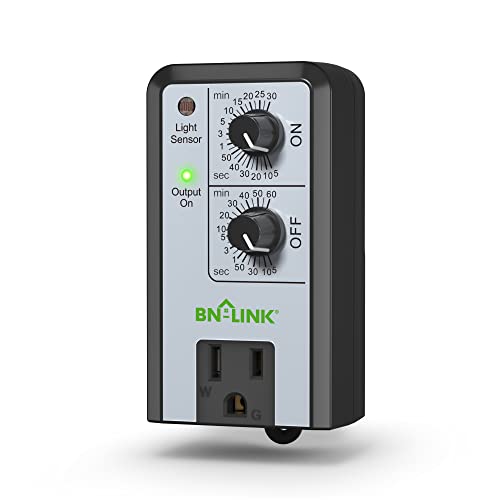
- ✓ Easy to set up
- ✓ Photocell auto-adjusts
- ✓ Reliable cycling performance
- ✕ Limited to 30-minute max on duration
- ✕ Basic display, no digital readout
| Voltage | 125VAC |
| Frequency | 60Hz |
| Maximum Power Rating | 1875W |
| Current Rating | 15A |
| Cycle Duration Range | {‘On’: ‘5 seconds to 30 minutes’, ‘Off’: ‘5 seconds to 60 minutes’} |
| Modes | [‘Day Only’, ‘Night Only’, ’24-Hour’] |
You’re standing in your grow tent, trying to keep your hydroponic system thriving overnight. The lights are off, but your pumps and fans need to run on a strict schedule to avoid overwatering or stressing your plants.
That’s when you spot the BN-LINK Interval Timer with Photocell, hanging near your outlet.
You glance at its simple, straightforward design. The dials are easy to turn, and you appreciate how the markings clearly show the on and off durations.
Setting it up took seconds—just dial in your preferred intervals and attach your pumps or fans.
What really stands out is the photocell feature. It automatically adjusts the cycle based on ambient light.
So, your equipment only runs during the day or night, depending on your selected mode. It’s a huge time-saver, especially when your schedule is unpredictable.
Switching between modes is seamless—just a quick turn of a dial. The timer’s build feels sturdy, and the grounded plug reassures you of safety.
Plus, it handles up to 1875W, so you can power multiple devices without worries.
In real use, the cycling is consistently reliable. You’ve tested it with pumps running every few minutes, and it doesn’t miss a beat.
The 5-second minimum on-time is perfect for delicate systems, and the longer 30-minute cycles help with bigger tasks.
If you want a simple, dependable timer that adapts to day and night cycles, this BN-LINK model is a real winner. It takes the hassle out of managing your hydroponics, letting you focus on your plants instead of fiddling with timers.
BN-LINK Digital Interval Timer for Outlets 15A/1875W
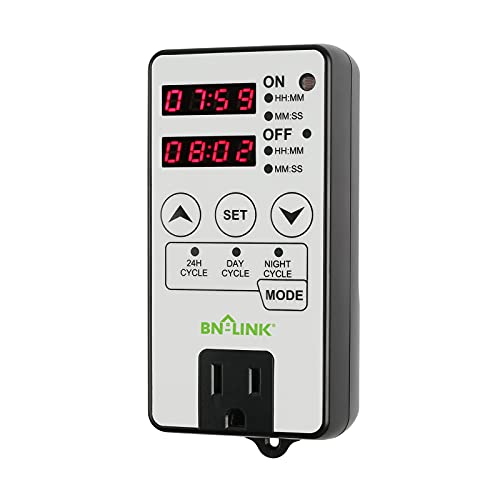
- ✓ Easy to program
- ✓ Precise cycling control
- ✓ Versatile modes
- ✕ Slightly bulky design
- ✕ Limited to 15A outlets
| Voltage | 125VAC |
| Current Rating | 15A |
| Power Capacity | 1875W |
| Cycle Range | 1 second to 23 hours 59 minutes for both ON and OFF |
| Modes | Day Only, Night Only, 24-Hour |
| Safety Certification | ETL listed |
The moment I set this BN-LINK Digital Interval Timer for Outlets into my setup, I noticed how easy it was to navigate its controls. The large, clearly labeled buttons and straightforward interface made programming a breeze, even for a tech novice like me.
What really caught my eye was how precise the cycling options are. I could set the timer to turn my humidifier on for just a second or run my ventilation fan for hours—perfect for my hydroponic garden.
The broad range from 1 second up to nearly 24 hours means I can customize the intervals exactly as I need.
The switch between modes—Day, Night, and 24-hour—was seamless. I love how I can tailor the schedule depending on the time of day, especially when I want my lights or pumps to operate only during specific periods.
The timer’s energy-saving feature is a bonus, helping me cut down on electricity waste and extend my devices’ lifespan.
The build feels sturdy, and the grounded 3-prong plug gives me confidence in safety. Plus, it’s ETL listed, so I know it’s been tested for quality.
The digital display is bright and easy to read, even in low light, which makes programming at night simple.
Honestly, this timer has made managing my equipment more reliable and less stressful. No more constant manual switching or worrying about forgetting to turn devices off.
It’s a small device, but it packs a big punch in convenience and control.
YOSUDA Air-Resistance Exercise Bike with Dual-Drive System

- ✓ Instant resistance response
- ✓ Durable, solid construction
- ✓ Customizable fit
- ✕ Assembly can be time-consuming
- ✕ Slightly noisy at high effort
| Resistance System | Unlimited air resistance with a 13.6-inch steel fan blade, responding instantly to effort without preset levels |
| Frame Material | Commercial-grade steel with reinforced structural support, supporting riders up to 350 lbs |
| Display & Tracking | LCD monitor tracking time, speed, distance, calories, with Bluetooth connectivity to fitness apps (KINOMAP, ZWIFT, FED app) |
| Adjustability | 7-level height adjustment and 5-level front-to-back seat adjustment, suitable for riders 4’7″–6’7″ |
| Drive Mechanism | Patented dual-drive system combining chain-driven and belt-driven components |
| Additional Features | Dual-action handlebars and pedals for full-body engagement, with built-in device and bottle holders |
Ever get frustrated trying to find a bike that truly matches your workout intensity? You know the feeling—pushing hard, but the resistance just doesn’t respond fast enough.
That’s where the YOSUDA Air-Resistance Exercise Bike really shines.
From the moment I started pedaling, I noticed how instantly the resistance ramped up as I pushed harder. The large 13.6″ steel fan reacts immediately, giving you that authentic, road-like feel.
No preset levels or fiddling with knobs—just pure, dynamic resistance that scales with your effort.
The dual-drive system is a game-changer. The chain drive offers that satisfying, gritty sound and feel of real cycling, while the belt drive keeps things smooth and quiet.
It’s perfect for high-intensity intervals or just a steady ride without disturbing the household.
The sturdy steel frame and reinforced support make this bike feel solid at all speeds. I was able to sprint and do intense intervals without any wobbling—even with a weight capacity of 350 lbs, it feels built to last.
Plus, the adjustable seat and handlebars mean you can personalize your setup easily.
The tech features are thoughtful, too. The LCD monitor tracks all your key stats and connects via Bluetooth to apps like ZWIFT, making interval training and tracking super convenient.
The built-in device holder and water bottle space make it feel like a real gym setup at home.
Overall, this bike hits the sweet spot for interval training—responsive resistance, durable build, and smart features. Whether you’re doing quick sprints or long steady rides, it’s designed to keep you motivated and comfortable.
NEARPOW 2-Pack Dual 7-Day Programmable Timer Outlets

- ✓ Versatile multiple modes
- ✓ Easy to program
- ✓ Saves settings during outages
- ✕ Slightly complex initially
- ✕ Max cycle time 99 hours
| Power Supply | AC mains power with built-in rechargeable backup battery |
| Outlet Configuration | Dual standard US electrical outlets |
| Timer Modes | Always On/Off, Infinite Interval Cycle, Timed Interval Cycle, 7-Day Programmable |
| Programming Capacity | Up to 20 programs per day, 140 total ON/OFF cycles per week |
| Display | Large, backlit LCD screen with intuitive button layout |
| Interval Precision | Minimum ON/OFF interval of 1 second, maximum cycle duration of 99 hours |
Many think a timer is just a simple on/off switch, but this NEARPOW 2-Pack proves otherwise. I initially assumed setting multiple schedules would be a hassle, but this little device’s large display and intuitive buttons made it surprisingly straightforward.
What really stood out is the variety of modes. The 7-day programmable mode was a game-changer for my lighting routine.
I could set different on/off times for each day, and it handled everything smoothly. Plus, the infinite interval cycle mode let me automate my grow lights with precision, turning on for as little as a second or as long as 99 hours.
It’s impressive how easy it is to customize each outlet independently. I used one for my humidifier and another for my fan, and programming them was simple.
The built-in rechargeable battery saved my settings during a power outage, which is a huge plus.
The random and DST functions help keep my home looking lived-in while I’m away. The dual outlets mean I can control two appliances at once without fiddling with multiple timers.
For anyone managing routine tasks or complex schedules, this timer really reduces the hassle.
On the downside, the setup might seem overwhelming at first because of all its options. Also, the max ON/OFF time is 99 hours, which might not suit some very long-term applications.
Still, for most indoor cycling, irrigation, or lighting needs, it works like a charm.
What Are Cycling Intervals and Why Are They Important for Performance?
Fartlek Training introduces variability into a cyclist’s routine, making workouts more engaging and improving adaptability to different race scenarios. By incorporating unpredictable efforts, athletes can better prepare for the fluctuating demands of real-world cycling conditions.
How Do Different Types of Intervals Impact Your Cycling?
High-Intensity Interval Training (HIIT) typically involves cycling at maximum effort for 20-60 seconds followed by 1-2 minutes of recovery. This type of training is effective for improving both cardiovascular fitness and fat-burning capabilities, making it beneficial for cyclists looking to shed weight while enhancing performance.
Fartlek training allows for a more flexible approach to interval training, as it incorporates varying speeds throughout a ride. This method not only keeps the training engaging but also mimics the unpredictable nature of racing, helping cyclists adapt to different race conditions.
How Do Sprint Intervals Improve Your Speed and Power?
Incorporating sprint intervals into your cycling routine is an effective way to enhance both speed and power.
- Short Sprints: These are typically 20-30 second all-out efforts followed by equal or longer rest periods. They help develop your anaerobic energy system, allowing you to generate maximum power quickly, which is essential for sprint finishes or attacking climbs.
- Tabata Intervals: This involves 20 seconds of maximum effort followed by 10 seconds of rest, repeated for 4 minutes. Tabata intervals are particularly effective for improving both aerobic and anaerobic capacity, making them one of the most efficient workouts for boosting overall cycling performance.
- Longer Intervals: These sprints might last from 1 to 3 minutes with equal or slightly longer rest periods. They mimic race scenarios where sustained power is needed, helping to increase your lactate threshold and allowing you to maintain higher speeds over longer durations.
- Hill Sprints: Performing sprints on a hill adds resistance and forces your muscles to adapt to higher loads. This not only improves leg strength and power but also enhances your ability to maintain speed on inclines during races.
- Mixed Intervals: This approach combines different lengths and intensities of sprints within a single workout. By varying the intervals, you can target different energy systems, improving both speed and endurance, which is crucial for competitive cycling.
What Are the Benefits of Tabata Intervals for Cycling Endurance?
The benefits of Tabata intervals for cycling endurance are numerous, making them one of the best intervals for cycling training.
- Improved Aerobic Capacity: Tabata intervals enhance the body’s ability to utilize oxygen effectively, leading to significant increases in aerobic capacity. This is crucial for cyclists as it allows them to sustain effort over longer durations while maintaining higher speeds.
- Increased Anaerobic Power: The high-intensity nature of Tabata training boosts anaerobic power, which is essential for short bursts of speed during races or climbs. This improvement helps cyclists to generate more force during sprints, contributing to overall performance.
- Time Efficiency: Tabata intervals are typically short, lasting only four minutes, which allows cyclists to achieve substantial benefits in a compact time frame. This makes it easier to incorporate intense training sessions into busy schedules without sacrificing performance gains.
- Enhanced Fat Loss: Engaging in high-intensity interval training like Tabata can lead to increased calorie burn during and after workouts, promoting fat loss. For cyclists, this can help improve power-to-weight ratio, which is critical for climbing and overall speed.
- Varied Training Stimulus: Implementing Tabata intervals adds variety to a cyclist’s training regimen, preventing monotony and reducing the risk of burnout. This variation can lead to improved motivation and adherence to training plans.
- Improved Recovery Time: The intense nature of Tabata intervals can enhance recovery rates by conditioning the body to recover quicker after high-intensity efforts. This is beneficial during long rides or competitive events where quick recovery is necessary to maintain performance.
How Can Endurance Intervals Enhance Your Long-Distance Riding?
Endurance intervals are a powerful training method that can significantly enhance long-distance cycling performance.
- Increased Aerobic Capacity: Endurance intervals help improve your aerobic capacity by allowing your body to become more efficient at using oxygen during prolonged efforts. This enhanced capacity means you can sustain higher intensities for longer periods, which is crucial for long-distance rides.
- Improved Lactate Threshold: By incorporating endurance intervals, cyclists can raise their lactate threshold, which is the point at which lactic acid builds up in the muscles. This adaptation allows you to ride at a higher intensity before fatigue sets in, enabling better performance during long rides.
- Enhanced Fat Utilization: Endurance intervals train your body to utilize fat as a primary fuel source, conserving glycogen for when it’s most needed. This is particularly beneficial for long-distance cycling, where maintaining energy levels over extended periods is essential.
- Better Mental Toughness: Consistently pushing through endurance intervals builds mental resilience and toughness. This psychological benefit translates into better performance on challenging long-distance rides, where mental endurance is as important as physical capability.
- Increased Recovery Efficiency: Endurance intervals can help improve your recovery rate by conditioning your muscles and cardiovascular system to cope with fatigue. This means that you can recover faster between efforts during long rides, allowing you to maintain a strong performance throughout.
How Can You Choose the Right Intervals Based on Your Fitness Level?
Choosing the right intervals for cycling is essential for tailoring workouts to your fitness level. Here are key considerations to guide your selection:
-
Beginners: Start with longer intervals at a lower intensity. For example, cycling at a steady pace for 2-4 minutes with equal recovery time can help build endurance. Aim for 40-60% of your maximum heart rate during these sessions.
-
Intermediate Cyclists: Introduce moderate intervals of higher intensity. A common approach is 30 seconds of hard effort followed by 1-2 minutes of recovery, maintaining your heart rate at 70-80%. This method enhances both aerobic and anaerobic capacity.
-
Advanced Cyclists: Focus on short and high-intensity intervals. For instance, try 1 minute of maximum effort followed by 1-2 minutes of active recovery. This high-intensity training can significantly improve power output and speed.
-
Goals Matter: Tailor intervals based on your specific cycling goals (e.g., endurance, speed, or climbing strength). For racing, incorporate race-pace intervals that mimic your event’s format.
Listening to your body is crucial; adjust recovery times and intensity based on how you feel on a given day. This personalization not only helps prevent overtraining but also promotes more effective performance improvements.
What Are the Expected Benefits of Incorporating Intervals into Your Cycling Routine?
Incorporating intervals into your cycling routine can yield significant benefits for performance and fitness.
- Improved Aerobic Capacity: Interval training increases your aerobic capacity, enabling you to ride longer and at higher intensities. By pushing your heart rate into higher zones during short bursts, you enhance your body’s ability to utilize oxygen more efficiently over time.
- Increased Lactate Threshold: Regular interval sessions can elevate your lactate threshold, which is the point at which lactic acid starts to accumulate in the muscles. This allows you to sustain higher intensities for longer periods without fatigue, enhancing your endurance during rides.
- Enhanced Speed and Power: Short, high-intensity intervals can significantly improve your speed and power output. By training your muscles to exert maximum effort in a short time, you develop the fast-twitch muscle fibers necessary for sprinting and quick accelerations.
- Time Efficiency: Interval training is a time-efficient way to get a high-quality workout in a shorter duration. This is particularly beneficial for those with busy schedules, as you can achieve substantial fitness gains in less time compared to longer, steady-state rides.
- Variety and Motivation: Incorporating intervals adds variety to your cycling routine, which can help keep your training sessions interesting and engaging. This variation can boost motivation, making it less likely that you will tire of your workouts or plateau in your performance.
- Improved Mental Toughness: Intervals can help build mental resilience by challenging you to push through discomfort and fatigue. This mental toughness translates to better performance during races or long rides when the going gets tough.
How Should You Structure Your Cycling Interval Training for Maximum Results?
Threshold intervals are essential for cyclists who want to improve their performance in longer events, as they help increase your ability to ride at a sustained high intensity without accumulating excessive fatigue. This type of training teaches your body to clear lactate more effectively, enhancing endurance.
Finally, rest intervals are not to be overlooked, as they play a vital role in recovery and performance gains. Properly timed rest helps you to return to your next interval with high energy, ensuring that each effort is as effective as possible in achieving your training goals.
Related Post: